Sexist messaging behind dress codes that tell young girls they’re to blame for unwanted sexual attention.
I didn’t expect to get in trouble for taking off my sweater, but I did. On an exceptionally hot day, I came inside from recess, sweaty but happy. I was 6 years old wearing a new tank top I had begged mom to buy at Justice during back-to-school shopping.
A teacher –not even my teacher– pulled me aside and informed me that my tank top was “unacceptable” and a violation of the school dress code. I was very confused, so I asked her why. What she said next confused me more and made me feel uncomfortable.
“Spaghetti straps are too distracting for the boys,” she said.
I remember feeling frustrated, as I pulled my sweater back on, still sweaty from a game at recess. How could my tank top be a distraction?
The older I got, the more trouble I faced for what I was wearing. My leggings were too tight, my shorts were too short, my developing body was “showing too much.” The list goes on. As a kid who loved fashion, I struggled with trying to toe the line between dressing like my fashion role models and being “dress coded.” Every violation was always because “it’s too distracting for the boys.”
My older sister, Iris, and I both hit puberty very early. I watched her come home frustrated at being targeted via dress code violation more often than her classmates. A couple of years after I got the warning about the tank top, this would soon happen to me too. She was told it was because the other girls “didn’t have breasts.” We first heard these messages as early as age 7 and 8.
The school we went to also had a dress code rule banning writing and popular media on clothing. While this pertained to everyone, almost the entire rest of the code targeted girls specifically. For example, our shorts could not be higher than where fingertips landed if we stood with our arms extended straight to our legs.
I remember very distinctly that the teacher who was the biggest “dress code stickler” had an office at the top of the stairs where all our middle school class rooms were. Her window faced the stairs. As the weather got hotter each year, I would walk up the stairs, desperately trying to pull my shorts down a couple inches to where my fingertips hit. She peered over her glasses at me walking toward her window each morning.
While some boys wore tank tops, I couldn’t wear them “because of my figure,” teachers told me. I tried to wear them anyway.
On days where a simple warning wouldn’t do, I was sent to our school’s theater department. Here is where I was forced to change into something from the costume room. I always tried to pick the loudest, craziest piece I could, maybe to simultaneously prove that these ridiculous costumes were more distracting than my jeans shorts or tank tops.
I knew our private school had a more strict dress code – enforced mostly by one teacher – than public schools. But when my sister comments from teachers on her body choices didn’t stop.
She was dress coded often by a male English teacher because of her thin straps, yet after Trump’s election in 2016, an older male student was not sanctioned for wearing a T-shirt that said: “Hillary sucks, but not like Monica.” She was furious, she said. “ “My shirt was deemed more sexually suggestive because you could see my shoulders than someone wearing a T-shirt with a message that obviously was a cruel sexual innuendo,” she said.
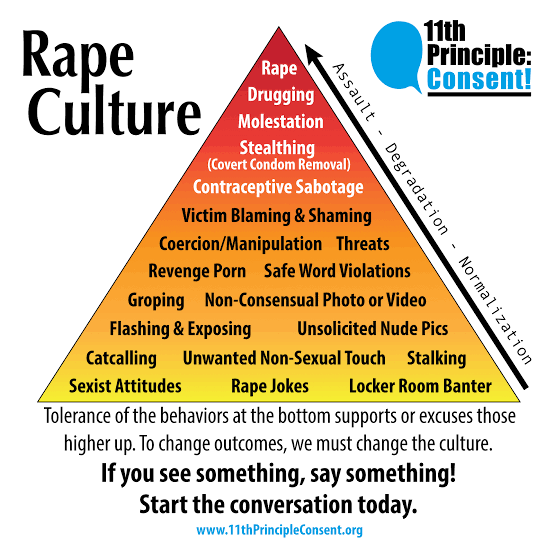
The rape culture pyramid, which has its intellectual origins in Susan Brownmiller’s 1975 book “Against Our Will: Men, Women and Rape,” is a visual framework that shows how subtle, everyday behaviors build a foundation that normalizes and enables sexual violence. Toward the top is victim blaming, or suggesting a woman is raped because her appearance enticed a man. But toward the bottom are sexist attitudes, and that’s where dress codes live. While dress codes are not overtly victim blaming, they set a narrative — that what a girl wears will result in unwanted attention from boys.
We don’t know what the woman in the Cornell University gang rape case was wearing. It doesn’t matter. What matters is that it occurred in a culture that had long been conditioned to accept male entitlement and shirk male accountability.
Earlier this month, just a few weeks after the woman filed a lawsuit against Cornell in that case, Shane Gillis appeared on Saturday Night Live and said that women at the gym “dress like whores” with tight clothing and shorts. “And don’t look! You’re not allowed to look,” he said.
People choose tight clothing at the gym for a variety of reasons. Comfort, the ability to see movement/muscle groups they are focusing on and the ability to move freely. But to men like Gillis, it’s apparently a barbed invitation.
Gillis got heat for his comments. But that hasn’t stopped the problem. Too many sexual assault or harassment survivors have been asked what they were wearing. Victim blaming doesn’t end with the clothes. Every choice a survivor makes is fair game for that blame. “Well, were you drunk?” “You said yes at first though, right?” “Didn’t you know about that fraternity’s reputation? ‘Sexual Assault Expected’?” Suddenly the messages are multiple: It’s not just watch what you wear; it’s don’t get drunk, don’t dance, don’t make eye-contact with men, don’t go to THAT bar.
All of it sends the same message to survivors: You could have prevented this from happening.
As a 6 year old, I could never have understood the weight of these cascading messages from my teacher’s directive to put on my sweater that hot day.
But as I look back, that was the beginning of the message: That the simple existence of my female body was a problem or an invitation.
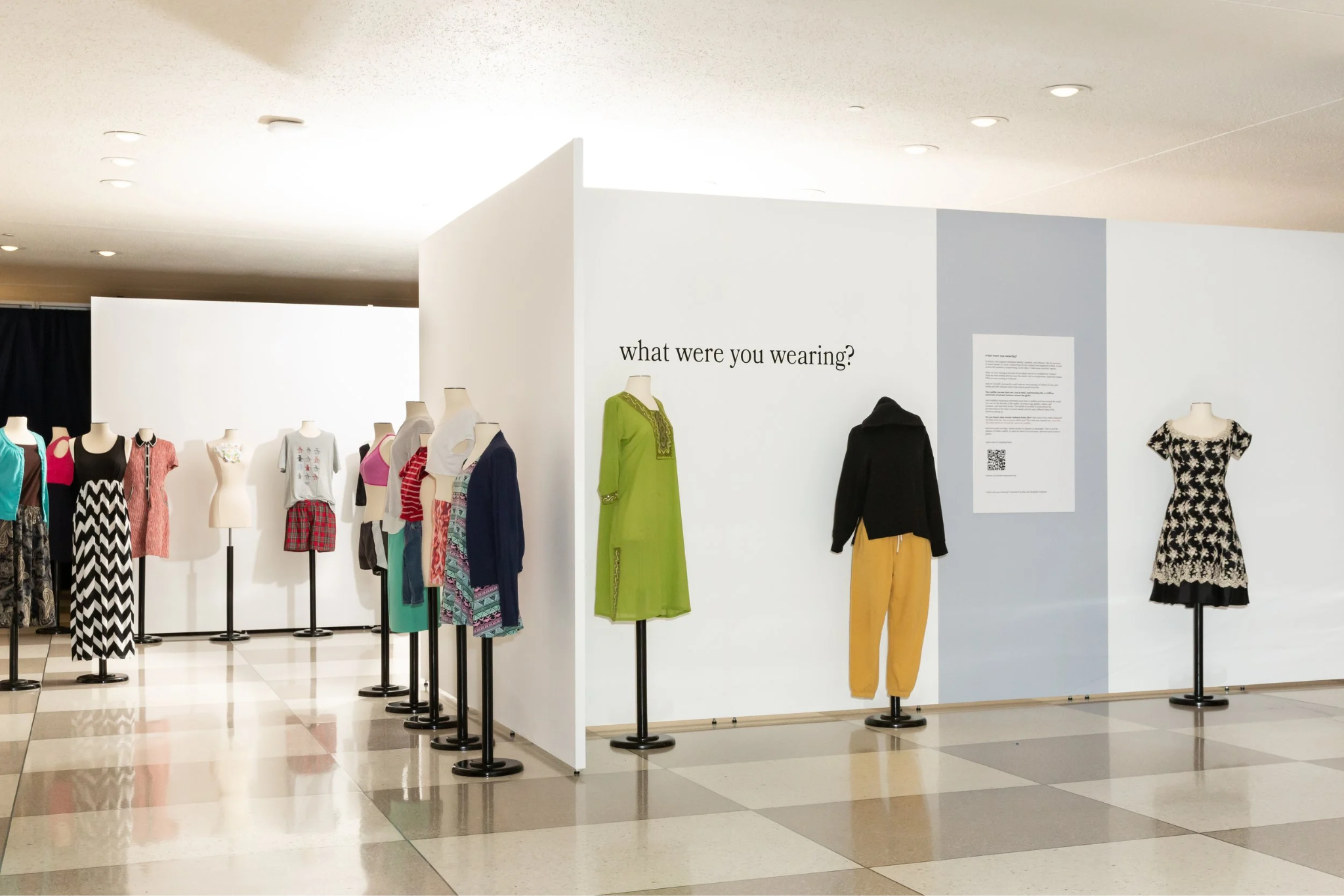
Featured Image shows Rise Organization’s Art Installation at the United Nations entitled “What Were You Wearing?” showcasing the clothing that victims of sexual assault were wearing when the assault occurred. Photo by Indie Studios.