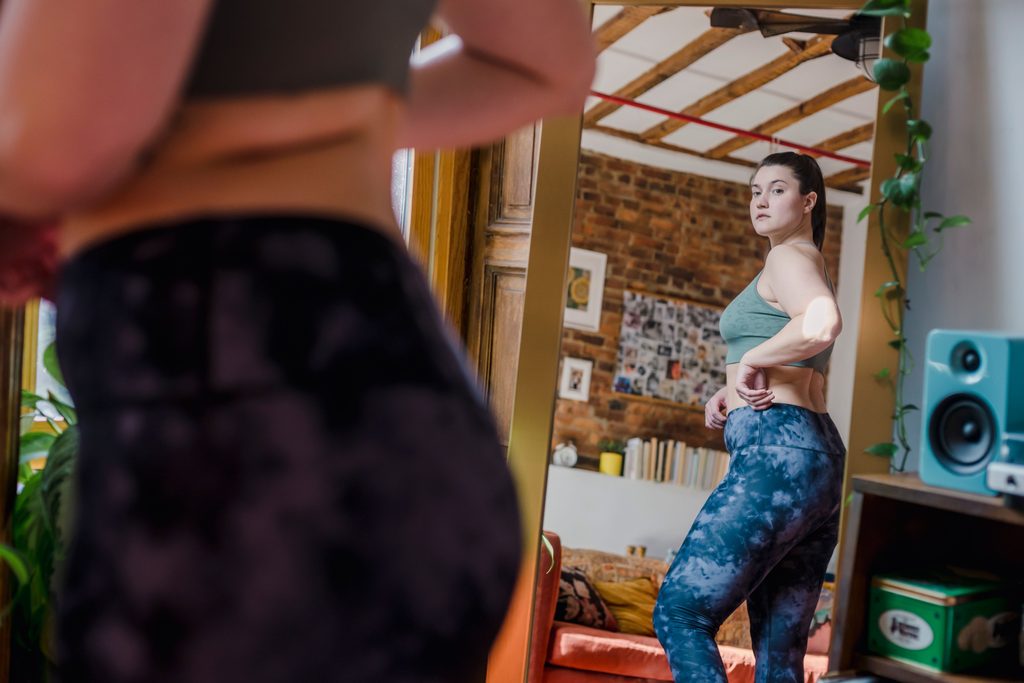
From the heroin chic aesthetic of the 1990s to today’s social media trends, beauty ideals keep changing. My experience with anorexia taught me the danger of measuring our worth against them.
By Aleide Achenbach
Some clothes in my closet take me back to when I was 18: brightly colored crop tops or light-wash jeans with knee rips. Sometimes I grab them from my drawers, slip them on and am shocked they no longer fit. Then I remember how carefully I shopped for them, searching for the smallest size a store had to offer. Whether it was an XS, an XXS, or a size 00, I wanted the validation of knowing I was among the tiniest people in the store, as if an XS tag were a gold medal. The smaller the size, the more proof I was becoming the person I thought I needed to be.
It was the spring semester of my senior year of high school. I was looking forward to college, a new state and a fresh start, but I had just been diagnosed with anorexia nervosa. After a difficult year marked by a breakup, a friend’s death, drama and cyberbullying, I had found my coping mechanism: being skinny. I felt invincible when I thought I looked thin, believing that if I was skinny at least no one could call me “fat” or “ugly.” Slowly, that belief took over. If a shirt pinched my skin or I woke up bloated, I could feel worthless in an instant. I measured my accomplishments in pounds and inches, believing that losing more would finally make me more.
My phone reinforced that judgment. As I scrolled through social media to “relax,” I encountered content about dieting advice, exercise routines, and girls whose bodies I wanted to emulate. The more I consumed, the more I compared my appearance to people on my screen. My feed seemed to offer endless ways to become smaller and closer to the body I believed would finally make me happy.
Eventually, the comparisons followed me offline. I studied the arms, legs, necks, and collarbones of my friends, family members and strangers. I wanted to be thinner than everyone around me, as if being the skinniest person in the room would make me the most accomplished. There was always another body to study and another ideal to chase.
Research suggests I was caught in an association among social media use, body-image concerns and disordered eating, including links involving social comparison and internalization of thinness ideals. The studies do not prove social media directly causes eating disorders, but they explain why appearance-focused content can be harmful for young users.
The fashion industry has long promoted particular body types as ideals. In the 1990s, the heroin chic aesthetic brought extreme thinness, pale skin and a tired, hollow-eyed appearance into high-profile fashion photography. The 1993 Calvin Klein Obsession campaign featuring Kate Moss, photographed by Mario Sorrenti, became one of the era’s defining images. Fashion historian Rebecca Arnold explores how the 1990s aesthetic linked thinness with sophistication and rebellion in her 1999 article “Heroin Chic.” The skinny, bare faced look of Kate Moss challenged the 1980s polished glamour trend consisting of big hair, bold makeup and athletic physique. But even a trend that challenges old ideals can create another narrow standard for beauty.
In a 2022 Cosmopolitan article, Katie Baxter reflects on her experience with an eating disorder. Being a teen in the 90’s Baxter recalls “returning home from a grueling and lonely day at school to compare myself to the emaciated frames on the internet.” Her words resonate with me and show images can become standards against which people judge themselves. Today, social media can make those comparisons feel constant by feeding appearance-focused content directly to users. The ideals can change, but the pressure to measure up remains.
I still have those clothes. They remind me of a time when I believed the smallest number on a tag could tell me something about my worth. Now, I try to question the messages they send. Fashion should give us ways to express ourselves, not physical requirements we must meet before we deserve to feel beautiful.
The ideal body will keep changing. What is praised today may be dismissed tomorrow, replaced by another look and another set of expectations. We cannot stop trends from changing, but we can challenge the power we give them. Maybe the most important thing we can do is stop treating our bodies as trends to keep up with and start treating them as our own. No clothing size can measure our worth, and no trend should get to decide it.